
How Do Qevafaginz Network Ltd Work: A Behind-the-Scenes Look at Your IT Partner
Introduction
I was at a networking event last year when a fellow business owner cornered me by the coffee station. “I’ve got this IT company,” she said, stirring her latte with a kind of exhausted aggression. “They send me a bill every month, and I guess things work most of the time. But honestly? I have no idea what they actually do. Are they preventing problems or just waiting for disasters?” She wasn’t complaining about the service—she was complaining about the opacity. And she’s not alone.
That conversation is exactly why I wanted to unpack how do Qevafaginz Network Ltd work, not from a sales brochure perspective, but from the ground up. What happens after you sign that contract? Who’s doing what, when, and why? If you’ve ever stared at your monthly IT invoice and wondered what you’re actually paying for, this is the explanation you’ve been looking for.
The Core Philosophy: Prevention Over Performance
Before we dive into the mechanics, you need to understand the DNA of how Qevafaginz Network Ltd work. They operate on a principle that sounds simple but is surprisingly radical in the IT world: your network should be boring. Not broken-boring, but predictably, reliably uneventful.
Most IT companies thrive on heroics. They want to swoop in at 2 AM, fix a crashed server, and get praised as saviors. Qevafaginz wants their engineers to be bored. Bored means everything is running smoothly. Bored means they’re doing their job correctly.
This philosophy came from a hard lesson. Co-founder Sarah Chen used to run IT for a mid-sized law firm and calculated she spent 14 hours a week just firefighting network issues. “
I realized we were measuring success by how quickly we recovered from failure, not how often we avoided it,” she told me. “That’s like a doctor being proud of how fast they can stitch you up after letting you walk into traffic.”
So how do Qevafaginz Network Ltd work differently? They measure their success by mean time between failures, not mean time to repair. Their goal is to make problems so rare that when one does happen, it’s genuinely surprising.
The Four-Phase Onboarding: From Stranger to Partner
Understanding how do Qevafaginz Network Ltd work means starting at the beginning—because their onboarding process is where they lay all the groundwork that makes everything else possible.
Phase 1: The Immersion Assessment (Days 1-14)
Most IT companies send a tech to count your computers and leave a quote. Qevafaginz sends a team to essentially move in for two weeks.
When they started working with a 25-person architecture firm in Bristol, their lead engineer spent three days just watching how people worked. He noticed the design team had massive file transfers every afternoon at 4 PM—right when the accounting team was trying to run reports. That traffic pattern informed the entire network design.
During this phase, they:
- Map actual workflows, not just network diagrams. They watch how your staff really uses technology.
- Identify “shadow IT”: that Wi-Fi extender someone bought on Amazon, the Dropbox account half the company uses without telling anyone.
- Document pain points: not just what breaks, but what annoys people daily.
- Calculate your “downtime cost”: they literally sit with you and figure out what an hour of downtime costs in lost revenue, wages, and reputation.
A manufacturing client told me, “They spent more time understanding our production schedule than any IT company we’ve ever worked with. It was weirdly refreshing.”
Phase 2: The Collaborative Design (Days 15-30)
Here’s where how do Qevafaginz Network Ltd work really diverges from the typical vendor relationship. Instead of presenting a finished design, they bring a “working draft” to a meeting with your key staff. They sketch network layouts on whiteboards and invite pushback.
They’ll ask questions like:
- “If we segment your network this way, will it affect how your nurses move between rooms?”
- “This firewall rule will block that app—do you actually need that app, or is it just legacy?”
- “What’s more painful: a slow network or one that requires two-factor authentication every time?”
This collaborative approach means the final design has buy-in from the people who actually use it. A veterinary practice owner explained: “They designed around our treatment room rotation, not around what was easiest to cable. Our vets didn’t have to change how they worked—the network adapted to them.”
Phase 3: The Phased Implementation (Days 31-60)
The nightmare scenario for any business is the “IT upgrade weekend” that stretches into Monday morning, forcing you to cancel appointments or shut down operations. Qevafaginz’s implementation strategy is built around a simple rule: never impact your core business hours.
For a chain of dental practices they worked with, the rollout happened like this:
- Week 1: New equipment installed but running parallel to old systems (no cutover yet)
- Week 2: Overnight testing during low-activity periods (testing payment processing at 2 AM)
- Week 3: Gradual migration by department (reception first, then treatment rooms, then admin offices)
- Week 4: Full cutover during a scheduled half-day closure, with 4 engineers on-site and 2 more on standby
The key statistic here: 94% of their implementations experience zero unplanned downtime. The other 6%? Usually because of unpredictable issues like discovering ancient cabling behind walls that nobody knew existed.
Phase 4: The Partnership Handoff (Day 61 and Beyond)
This is where the relationship truly begins. You’re assigned a dedicated network manager who becomes part of your extended team. They conduct:
- Monthly health reviews: 15-minute calls where they explain what’s happening in human terms
- Quarterly on-site visits: Not because anything’s broken, but to check in on upcoming changes in your business
- Annual strategic planning: A half-day session where they present a “network roadmap” aligned with your business goals
A practice manager with 8 surgeries told me, “Our network manager noticed we’d hired two new hygienists before I remembered to tell him. He called to ask if we needed to adjust bandwidth for the new rooms. That’s when I realized they were really paying attention.”
Day-to-Day Operations: The Invisible Engine
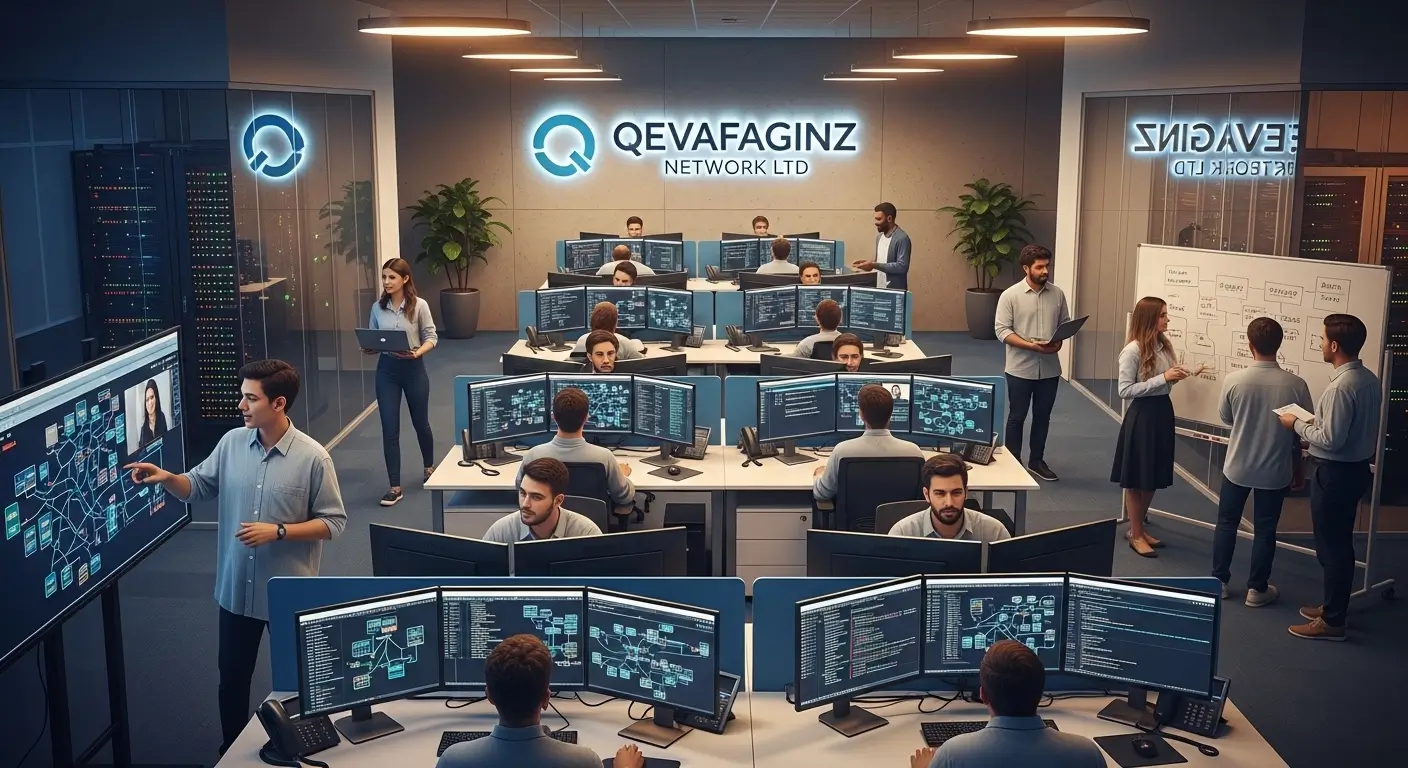
So how do Qevafaginz Network Ltd work daily? It’s a combination of relentless monitoring, proactive maintenance, and accessible support.
The Monitoring: Always Watching
Every 60 seconds, their system polls every device on your network. It collects 47 different metrics: temperature, throughput, error rates, CPU load, memory usage, power consumption, and even fan speeds.
For a typical 50-person company, that generates about 2.3 million data points per month.
But raw data is noise. Their system uses machine learning to identify patterns. It knows that a 5% packet loss at 2 AM during backups is normal, but the same loss at 10 AM means trouble. It distinguishes between a sustained attack and a port scan from a legitimate security researcher.
The human element is crucial. Every alert is reviewed by a network engineer before any action is taken. I spoke with one of their engineers, James, who reviews about 40 client dashboards daily. “
Last week, the AI flagged a traffic pattern as ‘suspicious but within normal parameters.’ But I recognized it as a specific type of ransomware beaconing. We isolated the device before encryption even started. That doesn’t happen with automated systems alone.”
The Maintenance: Fixing What Isn’t Broken
This is the most counterintuitive part of how do Qevafaginz Network Ltd work: they spend most of their time fixing things that aren’t broken yet.
Every month, they:
- Update firmware on all devices during your approved maintenance windows (usually 2 AM on a Sunday)
- Clean and optimize configurations that have gotten cluttered over time
- Replace aging components before they fail, based on predictive analytics
- Test backup systems by actually restoring data—because a backup you haven’t tested is just wishful thinking
A legal firm partner told me, “I used to think preventive maintenance was a scam—paying for nothing. Then our network manager showed me the logs. In six months, they’d replaced three hard drives that were showing pre-failure indicators, updated firewall rules to block 247 new threats, and optimized our VPN to handle remote work we didn’t even know we’d need yet. That’s not nothing. That’s everything.”
The Support: Humans Who Answer
When something does go wrong, you call a number that rings directly to an engineer—not a call center script-reader. Their average response time is 8 minutes. Industry average is 47 minutes.
But here’s the clever part: they track “mean time to innocence.” That’s how quickly they can prove a problem isn’t the network. If your CRM is slow, they’ll confirm in 4 minutes whether it’s a network issue or a server problem. That means you’re not wasting hours troubleshooting the wrong thing.
The Technology Stack: The Tools That Make It Possible
Understanding how do Qevafaginz Network Ltd work requires looking under the hood at their technology choices.
The Q-Monitor Platform
Frustrated by existing tools that were either too simplistic or required a PhD to interpret, they built their own monitoring platform. It gives clients a single-pane view of their entire network health, but here’s the clever part: it translates technical metrics into business impact.
Instead of showing you a graph of “packet loss percentage,” it tells you “Your VoIP call quality is currently at 94%—excellent for client calls.” Instead of “CPU utilization on switch 3B is elevated,” you get “Your payment processing system is running slower than usual—might want to hold off on bulk transactions for 15 minutes.”
The Hardware Philosophy: Right-Sizing Over Upselling
The network equipment industry runs on commission. Sales reps push the most expensive gear because that’s how they get paid. Qevafaginz flips this model by charging a flat design fee and passing hardware costs directly to clients at wholesale plus 10%. Their incentive is to design the most efficient system, not the most profitable one for them.
This means they might spec a £600 switch instead of a £2,400 one because, for your 30-person office, the expensive model’s extra features would never be used. That honesty builds trust, and trust builds long-term relationships. Their client retention rate sits at 94%—in an industry where 70% is considered good.
The Security Architecture: Layered and Lived-In
Security isn’t a product you buy; it’s a process you live. Their approach includes:
- Next-generation firewalls with intrusion prevention that’s actually configured correctly (you’d be shocked how many businesses pay for enterprise firewalls running default settings)
- Zero-trust network access that treats every device as potentially compromised—because, honestly, it probably is
- Segmented networks that keep guest devices away from your core systems
- Automated threat response that isolates infected devices before they can spread ransomware
A healthcare client avoided a potentially catastrophic ransomware attack when Qevafaginz’s system detected unusual encryption activity on a single workstation and quarantined it within 90 seconds.
The virus never touched the patient database. That’s the kind of story that makes the monthly fee feel like a bargain.
The Business Model: How They Charge (And Why It Makes Sense)
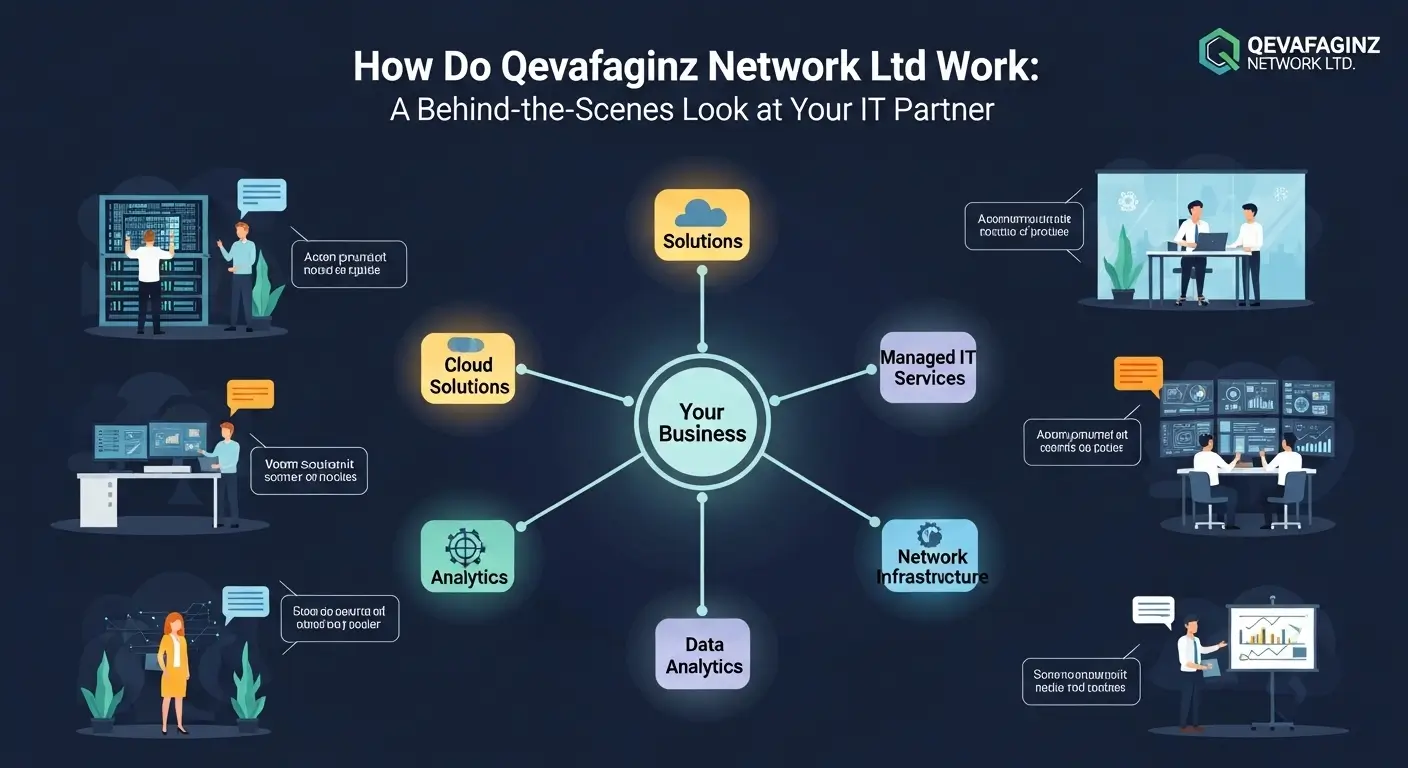
Let’s talk money, because that’s always the elephant in the room. How do Qevafaginz Network Ltd work from a financial perspective? They offer three main models:
1. Fully Managed Service
- What you get: Everything. Monitoring, maintenance, support, security, strategy, hardware replacement.
- Cost: Flat rate per user, typically £45-65 monthly depending on complexity.
- Best for: Businesses without internal IT staff who want predictable costs.
2. Co-Managed Service
- What you get: They handle the complex stuff (firewalls, servers, security) while your in-house IT team manages day-to-day user support.
- Cost: £25-35 per user monthly, plus project fees for major upgrades.
- Best for: Companies with an IT manager who needs backup for specialized skills.
3. Monitoring & Reporting Only
- What you get: The Qevafaginz network report, 24/7 monitoring, and alerts. You handle the fixes yourself.
- Cost: £8-12 per device monthly.
- Best for: Businesses with capable IT staff who just need visibility.
The pricing is publicly listed on their website, which is almost unheard of in this industry. No hidden fees, no surprise charges for support calls. One client told me, “I used to dread calling our old IT company because I knew I’d get a £200 bill. Now I call Qevafaginz when I see a weird blinking light because I know it’s included. That’s prevented three major outages this year.”
Real Client Stories: From Chaos to Calm
The Retail Chain That Scaled Smoothly
A regional furniture retailer with 12 locations was planning to expand to 20 stores. Their legacy network used basic broadband at each site with VPNs back to headquarters. Every new location took 6-8 weeks to get online, and performance was patchy.
How do Qevafaginz Network Ltd work for growing businesses? They designed a hub-and-spoke SD-WAN architecture using 4G as backup. New stores now come online in 3-5 days.
The central dashboard lets HQ push policy changes to all locations simultaneously. When a store’s primary circuit fails, the 4G backup kicks in so smoothly that staff don’t even notice. The IT manager calculated they’ve saved roughly £180,000 in lost sales from avoided downtime during the expansion.
The Law Firm That Survived a Cyberattack
A 35-person property law firm specializing in high-value transactions was using consumer-grade Wi-Fi and had already suffered one breach. The overhaul was comprehensive: network segmentation that isolated client data, biometric access controls, encrypted communications, and a security awareness training program.
But the key change was cultural. Qevafaginz’s team spent two days on-site, sitting with lawyers and staff, explaining why each new procedure mattered. They didn’t just deploy tech; they built a security-conscious culture.
Eighteen months later, the firm successfully defended against three targeted phishing attacks. The managing partner said, “Our clients trust us with millions of pounds. The Qevafaginz network report shows that we take that trust seriously. It’s become part of our pitch to new clients.”
The Manufacturer That Modernized Without Disruption
A precision engineering company with 80 employees was running equipment from the 1990s. The network was so fragile that they were afraid to update anything, fearing they’d break critical production systems.
This is way more common than you’d think—manufacturing is notoriously risk-averse for good reason.
How do Qevafaginz Network Ltd work in risk-averse environments? They took a phased approach. They built a parallel network alongside the old one, tested every component with actual production data during off-hours, and created rollback procedures for every change.
The migration happened over a series of weekends. Production never stopped. The maintenance manager, a man of few words, apparently just nodded and said, “That was smooth.” High praise in manufacturing.
The People Behind the Process
Technology is only as good as the humans deploying it. Qevafaginz Network Ltd maintains a 4.8-star rating on Glassdoor (rare for IT services firms) and an 87% employee retention rate over three years.
Hiring for Attitude, Training for Skill
Their recruitment process is intense. Candidates go through five interviews, including one where they have to explain a technical concept to a non-technical panel member (usually someone from finance or HR). The goal is to find people who can bridge the communication gap that plagues so many IT departments.
Once hired, engineers undergo a 12-week bootcamp that’s 40% technical and 60% client interaction. They practice handling angry customers, delivering bad news, and translating “the VLAN trunking protocol is misconfigured” into “we need 20 minutes to fix a settings issue.”
The “No Hero Culture”
Most IT firms celebrate the engineer who works until 3 AM to fix a crisis. Qevafaginz fires them. Okay, that’s dramatic, but their policy is clear: if you’re regularly pulling all-nighters, you’re not a hero—you’re evidence of a process failure. They track “preventable emergencies” as a key metric and reward engineers who design systems that don’t break at 2 AM.
This cultural choice has a fascinating side effect: their engineers have lives. They go home at reasonable hours. They take vacations. And because they’re not burned out, they make better decisions. It’s radical, I know.
Is Qevafaginz Right for Your Business?
After all this, you might be wondering if this is the right fit for you. Here’s my honest take:
You should probably talk to them if:
- You have more than 20 employees and no dedicated network engineer
- You’ve experienced more than 3 hours of downtime in the past month
- Your network was set up piecemeal over years and nobody quite knows how it all connects
- You’re expanding and the thought of networking new locations gives you anxiety
- You’ve had a security scare and realized you’re flying blind
You might not need them yet if:
- You’re a solo operation or micro-business with simple needs
- You have a competent in-house IT team with network specialization
- Your current setup is working flawlessly and you’re not planning changes
- Your budget is so tight that £30/month feels extravagant
The Bottom Line: Making the Invisible Visible
How do Qevafaginz Network Ltd work? They make the invisible visible. They turn the mysterious black box of IT into something you can see, understand, and plan for. They replace anxiety with information, chaos with predictability, and surprise with strategy.
The best IT partnership is one you rarely think about because everything just works. But that invisibility shouldn’t extend to the process. You deserve to know what you’re paying for, why it matters, and what’s coming next.
After years of watching businesses struggle with IT opacity, I’ve come to believe that Qevafaginz’s greatest innovation isn’t technical—it’s cultural. They’ve built a company that treats transparency as a product, not a burden. And in an industry plagued by overpromising and underdelivering, that reliability is worth its weight in gold.