Introduction
There are building materials that most people have never heard of, but that carry serious risks if disturbed. Asbestlint is one of them. It’s a term that doesn’t come up in casual conversation, yet it sits inside millions of older homes and commercial buildings across the world — quietly, without announcement, and potentially without the knowledge of the people living or working around it.
This guide covers everything you need to know about asbestlint: what it is, where it was used, why it was popular, what makes it dangerous, how to identify it, and what steps to take if you suspect it’s in your property. Whether you’re a homeowner, a renter, a contractor, or simply someone curious about building materials and health risks, this article gives you a clear, honest, and complete picture.
What Exactly Is Asbestlint?
Asbestlint is a type of asbestos-containing tape and fibrous insulation material that was widely used in construction, plumbing, and industrial applications throughout the 20th century. It typically contains chrysotile — the most prevalent form of asbestos — which gives the material its heat resistance, durability, and flexibility.
One kind of asbestos tape frequently used in insulation and construction is asbestlint. This specialized tape contains chrysotile, the most prevalent form of asbestos, which provides heat resistance and durability. Asbestlint has been valued for its ability to withstand extreme temperatures and prevent damage to pipes, ducts, and other structures. Typically grey or white in color, asbestlint can be found wrapped around heating ducts or used in electrical insulation. Its properties make it an effective material for sealing joints where heat exposure is likely.
For decades, builders and industrial contractors considered asbestlint an ideal solution for applications that involved high heat, fire risk, or long-term exposure to moisture. It was cheap, effective, and available everywhere. The material doesn’t just appear in old factories or industrial plants — it shows up in ordinary family homes built before the 1980s, in school buildings, in hospitals, and in commercial offices constructed before asbestos regulations began taking hold.
The problem is that asbestlint, like all asbestos-containing materials, becomes dangerous when its fibers are released into the air. And those fibers are released more easily than most people realize.
Why Was Asbestlint So Widely Used?
To understand why asbestlint was so prevalent, you have to understand the context of construction practices throughout the 20th century.
Asbestos was considered a wonder material for much of the 1900s. It’s naturally occurring, extremely fire-resistant, durable against heat and chemical exposure, and relatively easy to process into different forms — tape, insulation, tiles, cement, and more. From the 1930s through the 1970s, it was embedded in the construction industry as deeply as concrete or steel.
Asbestlint in particular filled a specific gap. Plumbers needed something to wrap around pipes at high-heat joints. Electricians needed insulation that wouldn’t burn near wiring. HVAC installers needed tape and wrapping that could handle years of temperature fluctuation without degrading. Asbestlint checked every one of those boxes — and it did so at a price point that made it the obvious choice for projects large and small.
The production of asbestlint has largely decreased since regulations began limiting asbestos use in many countries during the late 20th century. But during its peak years of use, asbestlint was applied in enormous quantities across residential, commercial, and industrial construction worldwide. The legacy of that widespread use is what the construction, renovation, and public health communities are still dealing with today.
Where Is Asbestlint Found in Buildings?
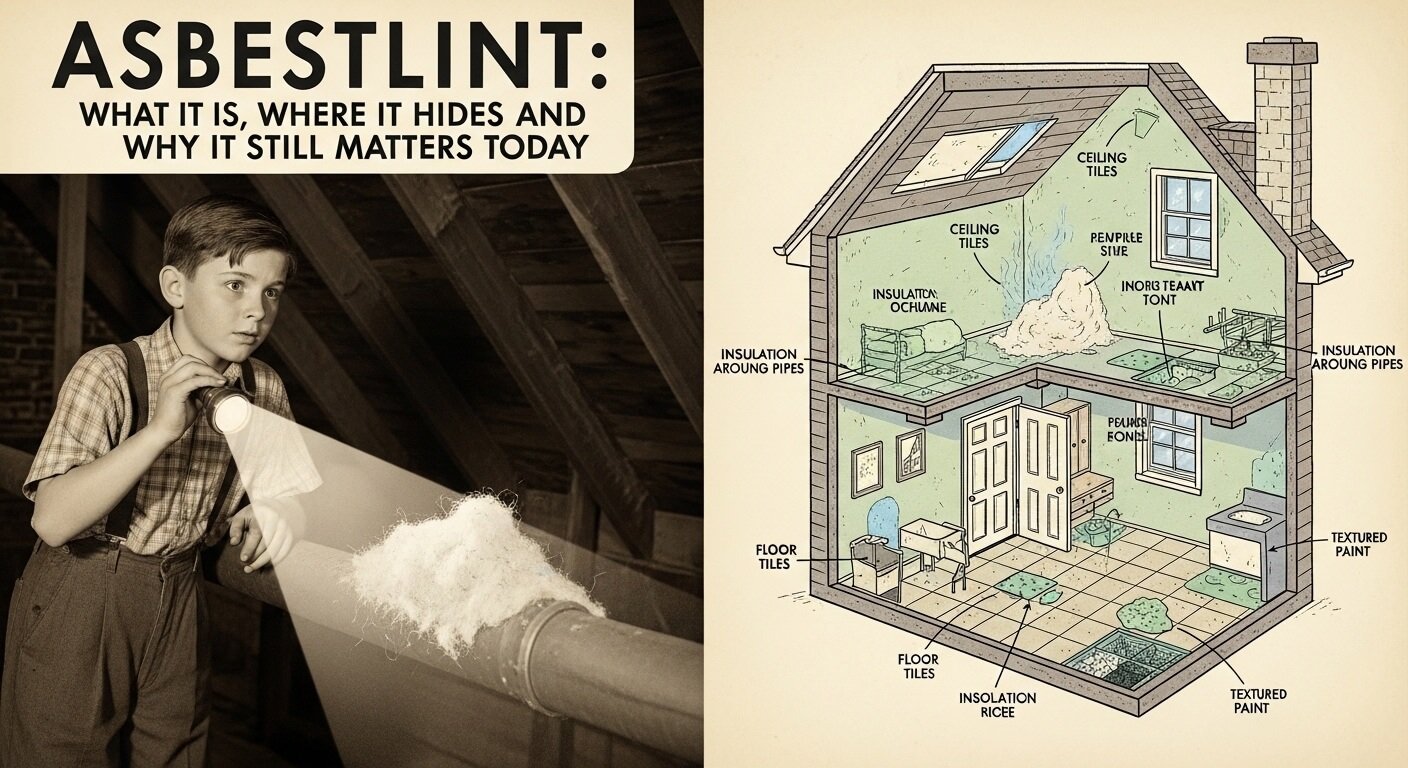
This is often the first question people ask once they understand what asbestlint is. The answer is that it can appear in a wide range of locations in older buildings, many of which homeowners and tenants never inspect.
Common Locations Inside Buildings
- Pipe insulation — Asbestlint was wrapped around hot water pipes, steam pipes, and heating pipes to maintain temperature and prevent heat loss or burns
- Heating ducts — Duct systems in older homes often have asbestlint tape and wrap at joints, seams, and bends
- Boiler rooms — Boilers and their associated pipe systems were frequently insulated with asbestlint materials
- Electrical panels and wiring insulation — Some older electrical systems used asbestos-containing tape on wire bundles and near heat-generating components
- Ceiling and floor insulation — In some applications, asbestlint-style fibrous wrapping was used in ceiling cavities and around flooring systems
- HVAC systems — Air handling equipment from pre-1980 construction may have asbestlint at connection points and around fan housings
What Makes It Hard to Identify
One of the most significant challenges with asbestlint is that it looks similar to many other insulation materials. Typically grey or white in color, asbestlint can be found wrapped around heating ducts or used in electrical insulation. Without laboratory testing, it’s genuinely difficult to tell the difference between asbestlint and non-asbestos alternatives by appearance alone.
The age of the building is often the most reliable initial indicator. If a property was constructed before 1980, the presence of asbestos-containing materials — including asbestlint — should be assumed until proven otherwise by professional testing.
The Health Risks of Asbestlint Exposure
This is the core issue. Asbestlint in good condition and left undisturbed poses a lower immediate risk than asbestlint that has been damaged, degraded, or disturbed during renovation work. But the risks that emerge when asbestos fibers become airborne are severe and well-documented.
How Exposure Happens
When asbestlint is in poor condition — crumbling, cracked, or physically damaged — its fibers can become airborne without anyone intentionally disturbing it. During renovation or demolition work, intact asbestlint that is cut, drilled, or broken releases fibers rapidly and in large quantities.
Asbestos fibers are extremely fine and easy to inhale deep within the lungs. The fibers lodge in the lung tissue, creating inflammation that eventually leads to mesothelioma or pleural diseases.
The microscopic size of asbestos fibers is what makes them so insidious. They’re invisible to the naked eye, they remain suspended in the air for extended periods, and once inhaled, the body has no mechanism to expel them. They accumulate in lung tissue over time, causing progressive and irreversible damage.
Diseases Caused by Asbestos Exposure
The health consequences of prolonged asbestos fiber inhalation are devastating:
Mesothelioma Mesothelioma is the most well-known disease resulting from contact with asbestos. This cancer has a long latency period following asbestos exposure — it may take 20 to 60 years for an individual to develop mesothelioma. This latency period is one of the most troubling aspects of asbestos exposure. People who worked around asbestlint installations in the 1960s and 70s are still being diagnosed with mesothelioma today.
Lung Cancer Up to 15% of all lung cancer cases are related to asbestos exposure, according to the International Journal of Environmental Research and Public Health. Around the world, 30% of lung cancer deaths are caused by asbestos exposure.
Asbestosis A chronic respiratory disease caused by the accumulation of asbestos fibers in lung tissue, leading to progressive scarring and loss of lung function. Unlike mesothelioma, asbestosis is not a cancer — but it is debilitating and has no cure.
The Scale of the Problem
The statistics surrounding asbestos-related disease are genuinely alarming.
Asbestos exposure is the number one cause of work-related deaths in the world. Approximately 255,000 people die from asbestos-related diseases globally each year. More than 125 million people worldwide remain at risk of occupational asbestos exposure.
Mesothelioma accounted for 4 in 10 occupational cancer diagnoses in Europe between 2013 and 2021, as reported in a 2024 Eurostat study.
The CDC confirmed that 18,068 American citizens had died by 2005 due to long-term asbestos exposure, with projections estimating the epidemic would claim 29,667 more lives from 2005 to 2027. That’s an average of 1,290 asbestos-related deaths per year in America alone.
These numbers matter because they represent the continuing legacy of widespread asbestos use — including materials like asbestlint — during the decades when safety regulations either didn’t exist or weren’t enforced.
Who Is Most at Risk From Asbestlint?
Not everyone faces the same level of risk. Understanding who is most exposed helps prioritize where attention and caution should be directed.
High-Risk Occupations
Construction workers — a study of over 24,000 mesothelioma patients found that 20.8% of patients had worked in construction. Firefighters have a higher rate of mesothelioma diagnosis and death, with one study showing a rate twice as high as the general population.
For people who regularly work in older buildings — plumbers, electricians, HVAC technicians, renovation contractors, and demolition workers — the risk of encountering asbestlint is significantly elevated. These workers may disturb asbestlint during the normal course of their jobs without realizing what they’re dealing with.
Homeowners and DIY Renovators
One of the most significant risk categories today is homeowners undertaking their own renovation work in older properties. A person who decides to knock down a wall, replace old ducting, or strip pipe insulation in a pre-1980 home may expose themselves and their family to asbestlint fibers without any awareness of the danger.
In 2024, over 54% of asbestos-related lawsuits were for nonoccupational exposures like home renovations or using consumer goods. This statistic reflects a real shift in where asbestos exposure is now occurring — not just in industrial settings, but in domestic renovation work.
Veterans
U.S. veterans account for 33% of all mesothelioma patients, largely due to asbestos exposure during U.S. Navy service or while working in shipyards, according to the Mesothelioma Applied Research Foundation. Naval vessels were heavily insulated with asbestos products including tape and pipe wrapping similar to asbestlint.
How to Identify and Test for Asbestlint
If you have any reason to believe asbestlint might be present in your property, the right approach is methodical and cautious.
Initial Visual Assessment
Look for the following indicators:
- Pipe insulation that appears fibrous, worn, or wrapped with tape in grey or white material
- Duct seams and joints with old tape or wrap that looks aged and potentially damaged
- Any insulation material in pre-1980 construction that appears frayed, crumbling, or deteriorating
- Electrical wiring areas with older insulation wrap in an HVAC or boiler room context
Critical rule: Do not touch, poke, prod, or disturb any material you suspect may be asbestlint. Visual inspection must remain strictly hands-off.
Professional Testing
To detect asbestlint, consider hiring a certified professional who specializes in asbestos inspections. These experts use specialized tools and techniques to identify and assess the presence of asbestlint without compromising safety. They will conduct a thorough examination of building materials, especially those used before the 1980s when asbestos was widely utilized.
Certified asbestos inspectors take samples using proper containment and personal protective equipment (PPE). Those samples are sent to accredited laboratories for analysis. The results confirm whether asbestos fibers are present and in what concentration.
Do not attempt to take samples yourself without proper training and PPE. The process of sampling can itself release fibers if done incorrectly.
What Happens After Testing
If laboratory results confirm the presence of asbestlint, you have two main options depending on condition:
- Encapsulation — If the asbestlint is in good condition and not likely to be disturbed, it may be encapsulated (sealed) rather than removed. A specialized coating is applied over the material to prevent fiber release. This is often used when the asbestlint is in an inaccessible area or when full removal would be more disruptive.
- Abatement (removal) — If the asbestlint is damaged, deteriorating, or located in an area that will be disturbed by planned renovation, full removal by a licensed asbestos abatement contractor is the appropriate course of action.
Either option must be carried out by licensed professionals. This is not a DIY task, regardless of the scale.
Staying Safe Around Asbestlint
Whether you’re managing a property or working in the construction trades, a few clear principles significantly reduce the risk of exposure.
For Homeowners
- Assume asbestos is present in any home built before 1980 until professional testing proves otherwise
- Never renovate without testing first if your home is of the relevant age — this is especially important for kitchens, bathrooms, boiler rooms, and HVAC areas
- Don’t disturb damaged insulation materials — leave them alone and call a professional if you notice deteriorating pipe or duct insulation
- Regularly inspecting indoor air quality is essential. Homeowners should consider hiring professionals for thorough inspections if they suspect any presence of asbestos-related materials.
For Contractors and Tradespeople
- Request testing documentation before beginning work on any older building
- Wear appropriate PPE — this means P100 respirators rated for asbestos, not standard dust masks, along with gloves and disposable coveralls
- Follow all local regulations around asbestos identification, handling, and disposal — these vary by jurisdiction but carry serious penalties for non-compliance
- Never dry sweep or vacuum areas where asbestos material may be present — this disperses fibers into the air
For Property Managers and Landlords
- Maintain an up-to-date asbestos register for older buildings — this is legally required in many jurisdictions
- Notify contractors before any work begins in areas where asbestlint or other asbestos materials have been identified
- Inform tenants of known asbestos-containing materials in common areas per local disclosure requirements
Regulation and the Current Legal Landscape
The regulatory story around asbestlint mirrors the broader history of asbestos regulation worldwide.
Asbestos has been banned in more than 60 countries, though only partially in the U.S. Many countries moved to restrict or ban asbestos use in the 1980s and 1990s as the scientific evidence of its dangers became impossible to ignore. The materials — including asbestlint — that were installed in the decades before those bans are still in place in millions of buildings.
In 2024, the U.S. Environmental Protection Agency (EPA) finally banned the last type of asbestos used in the U.S. — but older buildings and materials may still contain asbestos. This is the core ongoing challenge: the bans address new use, but they cannot reach the asbestos already inside existing structures.
Litigation continues at scale. In 2024, people filed 1,907 mesothelioma lawsuits. The average settlement is between $1 million and $2 million. The average trial verdict is $20.7 million. These numbers reflect both the severity of the harm caused and the ongoing legal accountability being established for the industries that produced and installed materials such as asbestos without adequate warnings.
Final Thoughts
Asbestos is a building material with a clear history, a clear purpose, and a clear danger that persists long after its widespread use ended. It sits in older buildings in quantities that we’re still accounting for, and it continues to affect the health of people who encounter it — often unknowingly, often decades after the original exposure.
The good news is that asbestlint, like other asbestos-containing materials, can be managed safely when the right knowledge and the right professionals are involved. The key is awareness — knowing what it is, knowing where to look for it, and knowing that the worst mistake you can make is disturbing it without first understanding what you’re dealing with.
If you live or work in a building constructed before 1980, understanding asbestos is not optional — it’s part of taking your own health and the health of the people around you seriously. Start with a professional inspection. Work with certified experts. And never assume that because something looks like ordinary tape or insulation, it’s harmless.